
A Classroom Guide to Teach Students to Spot AI-Generated Content
Have you ever scrolled through your feed and seen an image that looked... mostly right, but left you with a nagging sense of imperfection? Maybe it was a person with a perfectly symmetrical face but six fingers, or a sunset where the shadows seemed to be running in the wrong direction.
In 2026, we are encountering AI-generated content at a scale that often rivals or exceeds human-made media in many online spaces.. For our students, the challenge isn’t just learning how to use these tools, but learning how to identify a work made with these tools.
Today, let’s look at a fun, hands-on way to turn your students into "Digital Detectives" using a classic game: Two Truths and a Lie.
How to Spot an AI
Before jumping into the activity, students need to know what they’re looking for. AI has gotten much better at mimicking us, but it still leaves behind "digital fingerprints."
1. The Visual Glitches
Even the best models struggle with complex physics and anatomy (Read more about AI hallucinations and errors here).
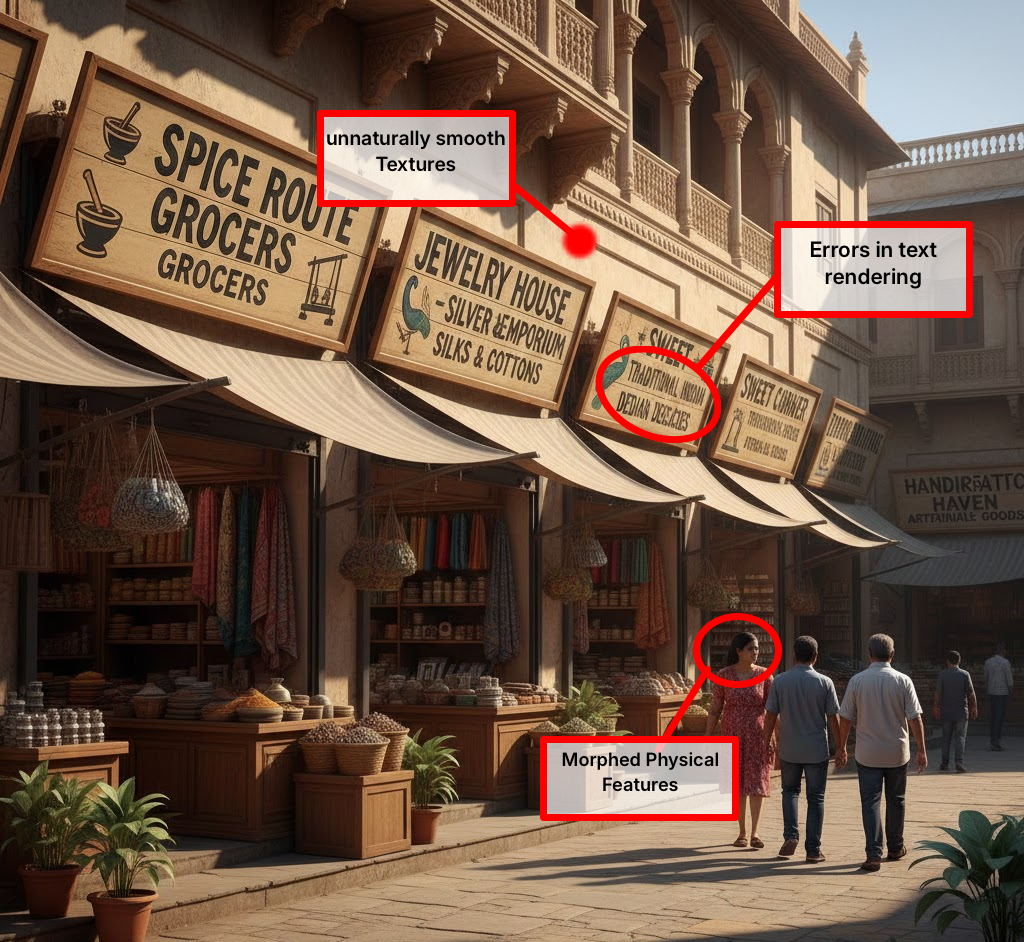
- The "Six-Finger" Rule: Check the extremities. Hands, toes, and ears are notoriously hard for AI to render perfectly. Look for deformed hands or jewelry that merges into skin.
- The Physics Fail: Look at reflections and shadows. Does the reflection in the water match the building above it? Often, AI ignores the laws of optics.
- Nonsensical Text: If there’s a sign or a book in the background, zoom in. Is it actual English (or Hindi), or just "AI-gibberish" that looks like letters from a distance?
- The "Too-Perfect" Sheen: AI images often have a hyper-saturated, plastic-like texture that lacks the natural "noise" or imperfections of a real photograph.
- Checking the background: AI often struggles with getting the elements in the background perfect. Check for imperfections in the background
2. Spotting AI written text
AI writing has a specific "vibe." AI written text can often be identified by the lack of personal touch and being very perfect.
- Excessive Metaphor: AI often uses a lot of metaphors in the text. Especially when instructed to write a creative text, AI is often very deliberate in adding metaphors and other creative references which doesn't sound so human.
- The Logic Loop: AI can be incredibly circular, repeating the same point in three different ways without adding new evidence.
- Lack of "I": Unless prompted, AI rarely shares a messy, personal human anecdote. Very generalised text can usually be attributed to AI generated content.
Classroom Activity: "Two Truths and a Lie" (AI Edition)
Once we expose students to the different strategies to detect AI gerenateed content, we can use this activity to test their skills and also to create more chance for discussion. This is a high-energy way to practice these skills.
Step 1: The Setup
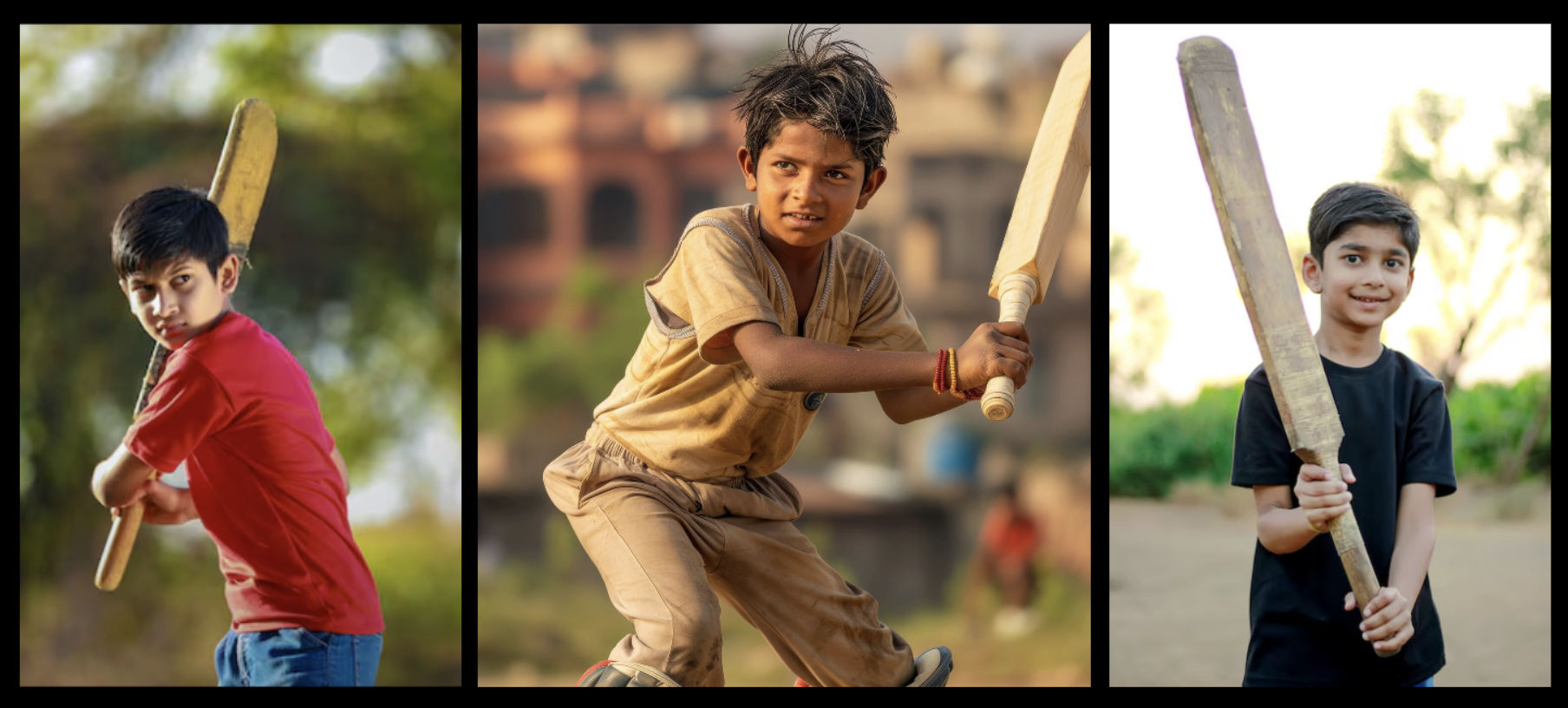
Prepare three sets of content. For each set, show two "Human-Made" items and one "AI-Generated" item.
Step 2: The Investigation
Give the students 2 minutes to inspect the images or text. Encourage them to look for the clues we discussed.
Step 3: The Vote & Debate
Students vote on which one is the "Lie" (the AI content). But here’s the crucial part: they must not only say which is AI generated by also say why they think so.
This discussion not only teaches them the skill to identify AI generate content but also builds the critical thinking skills. (Read here to know more about how to build critical thinking skills )
Beyond the activity: The Ethics of Transparency
As the session wraps up, it is essential to shift the conversation from "catching" AI to the ethics of "disclosing" AI.
We often tell students that AI is a powerful co-pilot, but with great power comes the responsibility to be honest.
We need to educate students that it isn't "wrong" to use AI to generate an image for a project, but it is unethical to pass it off as your own original photography. We want our students to imbibe the habit of Labelling and Citing. Just as they would cite a book, they should cite their AI collaborator. ( Read about other important aspects of an AI curriculum here )